


History
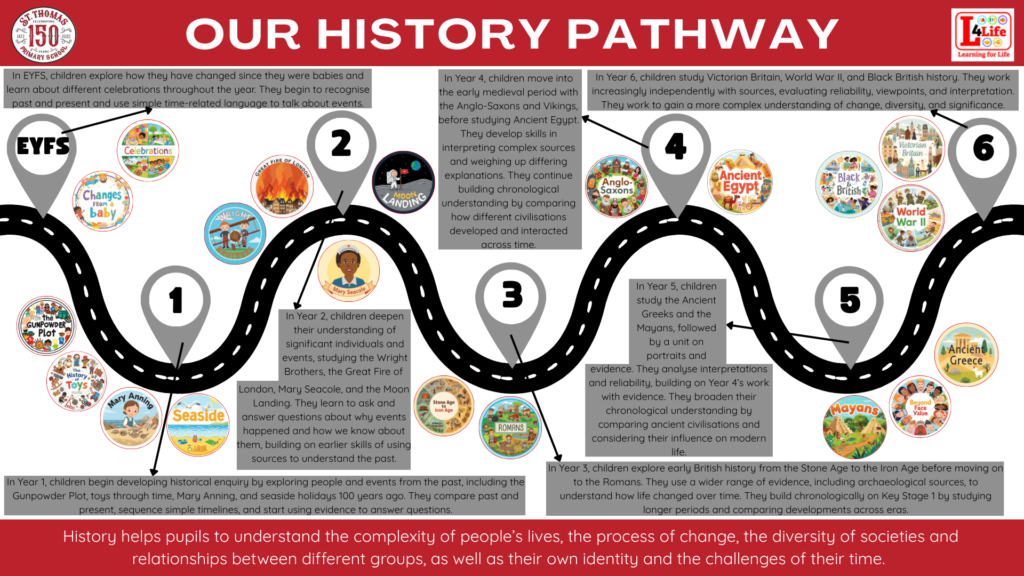
 At our school, we follow the Key Stage History curriculum, which brings the past to life through exciting and meaningful learning experiences. We want every child to develop a curiosity about the past and a sense of how history has shaped the world they live in today.
Through a range of engaging topics, pupils explore key people, events and periods from Britain’s past and the wider world. Our approach encourages children to ask questions, think critically, use evidence carefully, and develop their own understanding of how and why things have changed over time.
National Curriculum Links
Our History teaching follows the National Curriculum for History (2014), which aims to ensure that all pupils:
- Know and understand the history of Britain as a clear, chronological narrative — from the earliest times to the present day — showing how people’s lives have shaped the nation and how Britain has been influenced by the wider world.
- Know and understand significant aspects of the history of the wider world, including ancient civilisations, empires, past societies, and the achievements and mistakes of humanity.
- Use historical concepts such as continuity and change, cause and consequence, similarity, difference and significance to make connections, draw contrasts, analyse trends and ask meaningful questions.
- Understand the methods of historical enquiry, learning how evidence is used to make historical claims and how different interpretations of the past are formed.
- Gain perspective by placing their knowledge into different contexts — local, national and global — and understanding how aspects such as culture, economy, politics, religion and society interconnect.
The Key Stage History curriculum supports these aims through active, enquiry-based lessons that help children think like historians. They investigate evidence, explore different viewpoints, and learn to communicate their understanding clearly and creatively through writing, discussion and drama.
Developing Historical Understanding
Through the Key Stage History curriculum, children build a strong foundation of historical knowledge and skills. They learn to:
- Sequence events and understand chronology.
- Use historical vocabulary and terms confidently.
- Investigate artefacts, documents, maps and photographs as sources of evidence.
- Explore how past events have shaped life today, both locally and globally.
By the time they leave our school, pupils have developed curiosity, understanding and perspective — the tools they need to make sense of the past and appreciate their place in the present and future.
REACH and Learning for Life
Our REACH values — Respect, Equality, Aspiration, Community and Harmony — are woven throughout our history curriculum. As children study different time periods, they learn to respect diverse cultures and viewpoints, explore equality across societies, and develop a sense of community and harmony by understanding how people have worked together throughout history. We encourage aspiration by showing pupils that individuals can make a difference, no matter when or where they live.
We also embed our Learning for Life skills — Noticing, Thinking, Speaking and Listening, Teamwork and Perseverance — in every unit. Pupils learn to notice evidence, think critically, speak and listen thoughtfully, work together to investigate the past, and persevere when piecing together complex historical stories.
For more information about the Key Stage History curriculum, please visit the Key Stage History website.


